
About AgriProspects

Extension is Workforce Development

AgriProspects is a nation-wide effort to foster regional cooperation, identify workforce ecosystem gaps, and provide adaptive solutions to local and regional employment challenges utilizing the extensive resources and know-how of the Cooperative Extension System (CES). 

This initiative strengthens the adult agriculture workforce by connecting learners, earners, and employers to skill-building programs. Through our work, we showcase Extension-led opportunities that support career growth, community vitality and economic resilience. Because in Extension, all learning counts and workforce development is what we do.

For Extension professionals, AgriProspects offers resources to support the design and delivery of educational opportunities that connect learning to real-world outcomes. This includes tools and guidance for building industry- or agency-recognized educational opportunities, exploring emerging educational pathways, and developing digital and non-digital approaches to competency verification that support lifelong learning, career development, program sustainability, and workforce needs.

For employers, intermediaries, and others curious about or looking to engage with the Cooperative Extension System, we offer resources which provide insights into the CES and its role in education and workforce development in the United States. The Extension system is a vast, national network of non-traditional education which helps provide timely, relevant training and information within our communities and businesses. Extension can be a trusted partner in supporting your business, your staff, and your clientele. For CES administrators wanting to explore how these emerging opportunities benefit your institution, resources are provided to help you think through the pros and cons of more fully engaging with both digital and non-digital competency verification efforts in the non-credit educational space.

Regardless of who you are or what your need is, Extension’s existing and emerging educational efforts honor the complexity of the workforce needed to support agriculture within the United States. Extension is built around developing and delivering educational opportunities to those at varying stages of educational attainment and interests. We hope you see yourself in this matrix of opportunity; we encourage you to explore the resources on this page to learn more about workforce development, competency verification, and how the two can enhance impact and sustainability of both the workforce and Extension programs across the country.

Meet the AgriProspects Team

AgriProspects is supported by a national team of Extension professionals, regional coordinators, and project staff with experience across workforce development, agriculture, community development, data, engagement, and Extension programming. Learn more about the people helping connect Extension programs, partners, and workforce development opportunities across the country.

FAQs

Workforce development refers to the broad range of initiatives offered by government offices and agencies to help create, sustain, and retain a viable workforce. The objective of workforce development is to create economic prosperity for individuals, businesses, and communities. Workforce development focuses on an individual’s ability to grow his/her skills and develop the tools needed for career success. Workforce development typically includes education, training, and career navigation and employability services. (https://learnworkecosystemlibrary.com/glossary/workforce-development/)

Non-degree credentials include certificates, industry certifications, apprenticeships, educational certificates, occupational licenses, and digital badges. (https://learnworkecosystemlibrary.com/glossary/non-degree-credentials/)

At a basic level, Merriam-Webster defines workforce as:

  1. the workers engaged in a specific activity or enterprise
  2. the number of workers potentially assignable for any purpose

The US Bureau of Labor Statistics (BLS) defines labor force as “all people age 16 and older who are classified as either employed and unemployed.”

Someone is classified as employed  by BLS during their Current Population Survey if they “meet any of the following criteria:

  1. worked at least 1 hour as a paid employee
  2. worked at least 1 hour in their own business, profession, trade, or farm (self-employed)
  3. were temporarily absent from their job, business, or farm, whether or not they were paid for the time off
  4. worked without pay for a minimum of 15 hours in a business or farm owned by a member of their family

For criteria 1 and 2, the work must be for pay or profit; that is, the individual receives a wage or salary, profits or fees, or payment in kind (such as housing, meals, or supplies received in place of cash wages). For the self-employed, this includes those who intended to earn a profit but whose business or farm produced a loss.”

BLS classifies someone as as unemployed if they meet all of the following:

  • They were not employed during the survey reference week.
  • They were available for work during the survey reference week, except for temporary illness.
  • They made at least one specific, active effort to find a job during the 4-week period ending with the survey reference week….OR they were temporarily laid off and expecting to be recalled to their job.

People waiting to start a new job must have actively looked for a job within the last 4 weeks in order to be classified as unemployed. Otherwise, they are classified as not in the labor force.

Adult workforce development includes programming and products aimed at workforce members who are 18 years of age or older.

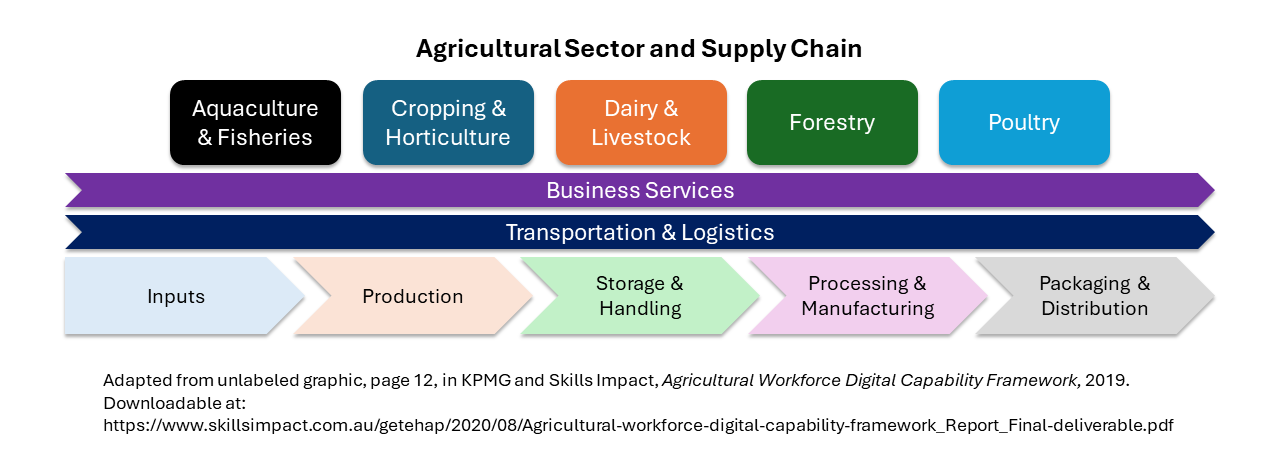
The agricultural sector varies from state to state and region to region across the country, so there is no simple way to define the agricultural sector. Further, there are many layers to this sector, ranging from primary production to processing and manufacturing to retail, many of which overlap with other sectors beyond agriculture.

To help applicants understand what may fit within the context of the agricultural sector, we created the following illustration, which we adapted from the 2019 Skills Impact report, Agricultural Workforce Digital Capability Framework. This framework is defined enough to help you identify the various components of the agricultural sector but flexible enough to allow for state, regional, and national variations in agricultural production.

Within each of these categories is a multitude of skills, trades, businesses, and opportunities for workers, the self-employed, and entrepreneurs. The following graphic provides some examples of what you might find within each. The example is by no means exhaustive and you may find in certain regions, states, counties, or farms something might be in multiple categories. Build your understanding around the needs of your audience and location.

Need more help? Don’t hesitate to reach out to our team for assistance!

NIFA maintains a map and listing of Land-Grant College & Universities, or more simply, Land-Grant Institutions, at the following website:

https://www.nifa.usda.gov/sites/default/files/2023-04/NIFALGUs_MapREV_AI0522_508.pdf

Some Land-Grants have specific structures set-up within them due to the nature of the institution (e.g. private university). Please work with your institution’s Office of Sponsored Programs or grants officer to determine your eligibility as a Land-Grant.

The National Cooperative Extension System is divided into six regions:

  • 1994 Region
  • 1890 Region
  • North Central Region
  • Northeast Region
  • Southern Region
  • Western Region

We’ve assembled maps for each region to help you navigate through where your and other Land-Grant Institutions are found. Our team of Coordinators is also distributed by region to better assist you in connecting within and across each. Don’t hesitate to reach out to our team for more information!

The proposal funding AgriProspects is from 2022, funding opportunity number USDA-NIFA-AFRI-009041, Program Area 7a. National Extension Clearinghouse for Industry and the Workforce (A7704).

© 2026 AgriProspects Workforce Development Network