From Learning to Opportunity Toolkit
A toolkit for building clear routes from Extension programs to real-world outcomes.

Extension is Workforce Development: Extension programs already help people build skills, apply knowledge, and move toward meaningful personal, professional, and community outcomes. This toolkit helps Extension professionals make those learning outcomes clearer, more visible, and easier to communicate through verified credentials.
Whether you are exploring certificates, industry certifications, licenses, badges, apprenticeships, assessments, or other forms of recognized learning, this toolkit provides a starting point for thinking through what your program verifies, who the credential is for, and how it can create value for learners, employers, institutions, and communities.
This toolkit can help you:
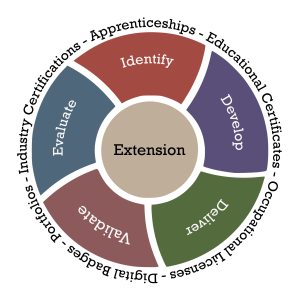
Strong credential pathways begin by identifying audience, market, institutional, and partner needs; developing aligned curriculum and credentialing strategies; delivering learning experiences tied to real-world skills; documenting completion and competency; and evaluating whether credentials support learner success and employer uptake.
This model shows how Extension and education providers support workforce development by creating learning opportunities, helping learners build and verify skills, connecting those skills to employer needs, and using industry feedback to improve future programming.
What Is a Non-Degree Credential?
Non-degree credentials are ways to document learning, skill attainment, competency, participation, or professional readiness outside of a traditional degree program. Across Extension, these credentials may include certificates, industry certifications, occupational licenses, apprenticeships, CEUs, badges, assessments, skill assertions, and other recognized learning endpoints.
In many cases, Extension programs already use these kinds of endpoints. The opportunity is to make them clearer, more consistent, and more valuable to the people who earn, recognize, or rely on them.
For example, a credential in “Small Farm Business Planning” might be a collection of individual learning opportunities combined together to showcase a learner’s skills in aspects of financial management, marketing and sales, and business planning and strategy. Similarly, a credential in “Community Health Outreach” might reflect demonstrated knowledge around public health messaging and communications, local resource identification and coordination, and facilitation of discussions around health related topics.
From Analog to Digital Credentials
Extension has used non-degree credentials for decades, from paper certificates and CEUs to licenses, certifications, and other forms of recognition. Digital credentials build on this history by making learning easier to verify, share, transport, and connect to future opportunities.
But digital is not the destination by itself. The strongest credentialing decisions begin with the same core questions, regardless of format: What learning occurred? What skill or competency was gained? How was it verified? Who recognizes it? How will the learner use it?
| Endpoint for Learners | Examples |
| Apprenticeship/Fellowship/Internship | On-the-job training, mentorship, practical experience |
| Certification | Industry-specific credentials, exams, standardized tests |
| Certificate of Completion | Proof of completion of a course or program |
| CEUs/PDCs | Continuing education units, professional development credits |
| Credential/Badge | Digital badges, micro-credentials, blockchain credentials |
| License | Government-sponsored permission to practice |
| Skill Assertions | Self-reported skills evidenced by portfolios or substantive products |
| Assessment/Testing | Pre/post understanding quizzes, real-world performance tests |
| General/Not Specified | Unspecified or broad validation methods |
What Makes a Credential Valuable?
A credential is more than a certificate, badge, or document. It is a signal that learning happened, a skill was gained, and that achievement has value to someone beyond the course itself.
A credential is strongest when it is:
Verified — It is connected to clear evidence of participation, completion, skill, or competency.
Valued — It matters to the learner, employer, institution, partner, or community.
Visible — It can be communicated, shared, recognized, or used in meaningful ways.
Whether the credential is a paper certificate, digital badge, CEU, license, assessment, or portfolio, its value depends on whether it clearly communicates what was learned, how it was verified, and why it matters.
Not sure where to start?
New to credentialing? Start with the white paper.
Planning at the institution or program level? Use the Program Admin Checklist.
Designing or revising a specific offering? Use the Extension Educator Credentialing Checklist.
Trying to understand credential types? View the Endpoint Types guide.
A foundational guide for Extension professionals exploring how to build verified, valued, and visible credential pathways through certificates, industry certifications, licenses, badges, apprenticeships, assessments, and other recognized learning.
A planning tool for administrators and program leaders considering the institutional, partnership, technology, policy, and implementation needs involved in developing credentialed learning opportunities.
A checklist to help Extension educators think through whether a program should include a credential, what learning or skill is being verified, who the credential is for, and how it may create value for learners, employers, partners, and institutions.
Cooperative Extension Director Jorge Atiles discusses the role of Extension in workforce development and opportunities for strengthening partnerships.
A quick-reference guide to common credentialing and learning endpoints
AgriProspects supports Extension professionals working at the intersection of learning, credentialing, and adult agricultural workforce development. Explore the resources below to connect your programs to broader workforce opportunities, learn from projects across the Cooperative Extension System, and find support for your next step.

The Extension Foundation is a nonprofit established by Extension Directors and Administrators nationwide. Extension Foundation is embedded in the U.S. Cooperative Extension System and serves on Extension Committee on Organization and Policy (ECOP).
This work is supported by the Agriculture and Food Research Initiative (AFRI)-National Extension Clearinghouse for Industry and the Workforce, project award no. 2023-67037-40533, from the U.S. Department of Agriculture’s National Institute of Food and Agriculture. Any opinions, findings, conclusions, or recommendations expressed in this website and consultative support are those of the author(s) and do not necessarily reflect the view of the U.S. Department of Agriculture or the Extension Foundation.