
Grant Program Frequently Asked Questions

The following is a compiled list of questions around AgriProspects’s grant program. Browse the entire list or use one of the topics links to pare down the list to what you’re interested in. Please reach out to one of our coordinators for any questions not answered here or elsewhere on the site!

At a basic level, Merriam-Webster defines workforce as:

  1. the workers engaged in a specific activity or enterprise
  2. the number of workers potentially assignable for any purpose

The US Bureau of Labor Statistics (BLS) defines labor force as “all people age 16 and older who are classified as either employed and unemployed.”

Someone is classified as employed  by BLS during their Current Population Survey if they “meet any of the following criteria:

  1. worked at least 1 hour as a paid employee
  2. worked at least 1 hour in their own business, profession, trade, or farm (self-employed)
  3. were temporarily absent from their job, business, or farm, whether or not they were paid for the time off
  4. worked without pay for a minimum of 15 hours in a business or farm owned by a member of their family

For criteria 1 and 2, the work must be for pay or profit; that is, the individual receives a wage or salary, profits or fees, or payment in kind (such as housing, meals, or supplies received in place of cash wages). For the self-employed, this includes those who intended to earn a profit but whose business or farm produced a loss.”

BLS classifies someone as as unemployed if they meet all of the following:

  • They were not employed during the survey reference week.
  • They were available for work during the survey reference week, except for temporary illness.
  • They made at least one specific, active effort to find a job during the 4-week period ending with the survey reference week….OR they were temporarily laid off and expecting to be recalled to their job.

People waiting to start a new job must have actively looked for a job within the last 4 weeks in order to be classified as unemployed. Otherwise, they are classified as not in the labor force.

The following definition was created by the Extension Committee on Organization and Policy (ECOP)  Economic and Workforce Development Program Action Team to assist in identifying activities and programs which may be considered ‘workforce development’, whether explicitly or implicitly:

Workforce development is equipping and preparing the workforce for the future of work by shifting what, where, and how the workforce is developed. Workforce development is worker centric on personalized learning, leadership, experiences, and growth in the flow of life that considers both the dynamic nature of jobs and the equally dynamic potential of people to reinvent themselves.

Workforce development helps organizations define the skills and capabilities needed for their future business strategy; identify key gaps in the current workforce; and create innovative strategies and programs to build, buy, borrow, and apply those capabilities—all with the “worker in the center.”

Workforce development strategies are worker centered to cultivate capabilities.

Adult workforce development includes programming and products aimed at workforce members who are 18 years of age or older. For programs that span adult and non-adult audiences, the primary audience must be adults.

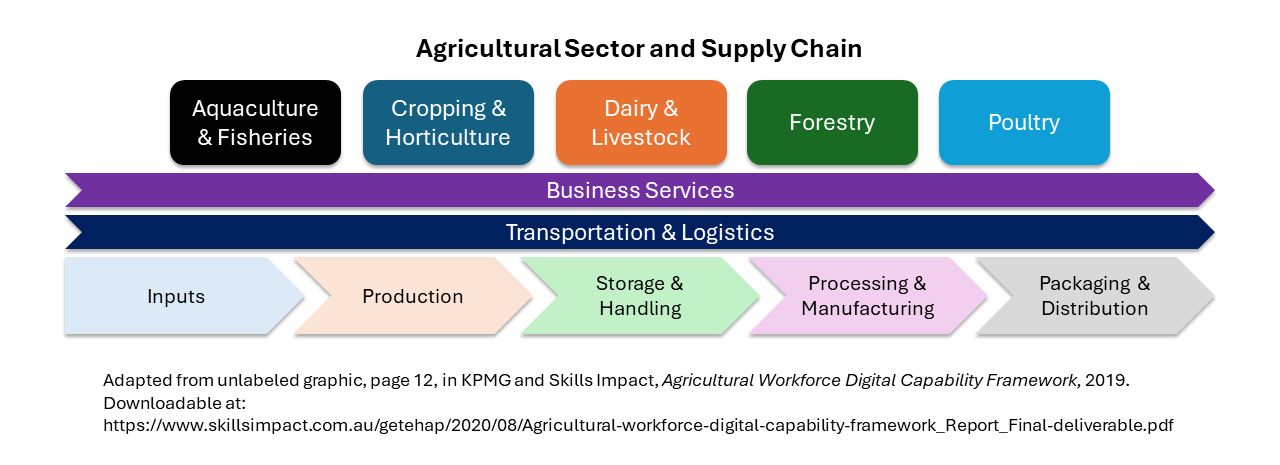
The agricultural sector varies from state to state and region to region across the country, so there is no simple way to define the agricultural sector. Further, there are many layers to this sector, ranging from primary production to processing and manufacturing to retail, many of which overlap with other sectors beyond agriculture.

To help applicants understand what may fit within the context of the agricultural sector, we created the following illustration, which we adapted from the 2019 Skills Impact report, Agricultural Workforce Digital Capability Framework. This framework is defined enough to help you identify the various components of the agricultural sector but flexible enough to allow for state, regional, and national variations in agricultural production.

Within each of these categories is a multitude of skills, trades, businesses, and opportunities for workers, the self-employed, and entrepreneurs. The following graphic provides some examples of what you might find within each. The example is by no means exhaustive and you may find in certain regions, states, counties, or farms something might be in multiple categories. Build your understanding around the needs of your audience and location.

Need more help? Don’t hesitate to reach out to our team for assistance!

NIFA maintains a map and listing of Land-Grant College & Universities, or more simply, Land-Grant Institutions, at the following website:

https://www.nifa.usda.gov/sites/default/files/2023-04/NIFALGUs_MapREV_AI0522_508.pdf

Some Land-Grants have specific structures set-up within them due to the nature of the institution (e.g. private university). Please work with your institution’s Office of Sponsored Programs or grants officer to determine your eligibility as a Land-Grant.

The National Cooperative Extension System is divided into six regions:

  • 1994 Region
  • 1890 Region
  • North Central Region
  • Northeast Region
  • Southern Region
  • Western Region

We’ve assembled maps for each region to help you navigate through where your and other Land-Grant Institutions are found. Our team of Coordinators is also distributed by region to better assist you in connecting within and across each. Don’t hesitate to reach out to our team for more information!

The proposal funding AgriProspects is from 2022, funding opportunity number USDA-NIFA-AFRI-009041, Program Area 7a. National Extension Clearinghouse for Industry and the Workforce (A7704).

The overarching audience for the NECIW grant is the adult agricultural workforce. Our intent is for proposals in each track to build capacity within and across Extension for the ultimate goal of positively impacting the adult agricultural workforce. To this extent, your audience could be Extension solely, agricultural producer/industry based (e.g. train-the-Extension-trainer to then train the workforce), or some combination of audiences. Keeping the endpoint audience in mind while crafting your narrative will help identify the key problems and issues you are trying to address through your proposed activities.

In round one, audience members were engaged in a variety of ways. Some were involved as partners in the development of the proposal. Some were engaged in various aspects of curriculum development. Others were engaged in refining existing curriculum.

How you engage your audience in your grant is ultimately up to what you are proposing. Our ask is that you engage your audience in a meaningful and impactful way in the grant process, not just as a recipient of your activities.

No. One track is not being prioritized over the other. Proposals will be scored on their own merits and the top scoring proposals selected for funding regardless of track. It is a possibility that no projects will be selected within a specific track.

We have identified funding up to 5 proposals at $200,000 each, for a total of $1 million dollars. If the budgets for the top scoring proposals would total less than the total available funding, we will consider funding additional projects. Until the finalists are selected, we cannot say that this will be a possibility.

Yes, you may submit an application as lead PI in both tracks. You may also be a co-PI on multiple applications. However, an applicant can only be the lead PI on one award. Current & Pending may be a factor and we reserve the right to adjust the award(s) accordingly.

Yes, you can include elements of both tracks in your application, but you cannot stack funds by doing this.

The grant round does not have a preconceived notion of how AI will or should be included in a proposal. We suggest a number of potential integration such as:

  • AI literacy training
  • Train the trainers
  • Tools for decision-making or supply chain optimization
  • Collaboration with tech partners

As noted in the audience FAQ question, how you choose to use AI in support of your project – and ultimately your target audience – is at your discretion.

Here are two suggested resources to help you find potential AI partners for your grant:

The expertise does not need to come from within your institution or Extension. You can partner with a tech provider (e.g. Google, Microsoft, etc.) or some other resource outside of the Land-grant system.

Yes, ExtensionBot can be utilized as part of your proposal. You can find more information and contact the Extension Foundation AI team at this link: https://extension.org/tools/extbot/

There are a variety of resources on the ExtensionBot website, including a decision tree to help you understand what may be involved in utilizing ExtensionBot resources as well as contact information.

How you utilize this or any tool should be developed in keeping with both the overall grant goals outlined in the RFP and this FAQ and the goals and audiences for your proposal.

Yes, you can have as many PIs as you can manage and afford. We will need C&P and CVs for each PI.

This is up to the applicant to define. Your partnerships will help define this term. Projects proposed around one institution must demonstrate scalability.

The timeline and other templates are to assist you in developing your thinking. Please utilize the expected dates in the RFP to fill the timeline out. Please be aware that contracting will drive the actual start and end dates, so your timeline is subject to change.

No. You may use whatever tools you have at your disposal. We provide these as support tools, not as required documents. The key is to use the logic of these tools to effectively to support your proposal.

A partner is anyone providing tangible support to your project. This may be through in-kind services, compensated services, or helping you connect with audiences and opportunities. In some respects you get to define who partners are as related to your project.

While not strictly required, it is strongly recommended to have letters of support from your partners. Their letters should highlight their contribution to the project.

Not necessarily. Partners can provide in kind services for your grant or they can be compensated for these services – that is up to the applicant.

If you are compensating a partner or partners in your grant, please be sure to

  1. indicate what work they will be accomplishing within the narrative portion of your application
  2. identify them in your budget, and
  3. work with your OSP/Grants Office and use the Contractor or Subrecipient Questionnaire provided in the grant support material folder to work through how the partner is connected to and compensated by the grant.

If they are providing in-kind services of some sort, please be sure to have them indicate these services in their letter of support.

The AOR letter signifies your institution’s commitment to the financial obligations of the contract. The Extension Administrator letter commits your time and resources to the project.

Yes, credit courses are not eligible for this grant opportunity. The AFRI RFA  for the NECIW grant specifically identifies what we can and cannot support:

“Curriculum for workforce training developed, expanded, or improved under this program area must lead participants to earn industry accepted certifications. (Certificates, training or coursework for/part of baccalaureate or post-graduate degrees or training ARE NOT supported under this program area priority).” [emphasis in original]

Based on this, credit bearing courses are not permissible under this grant opportunity. If the same courses could be altered to focus on a credential or industry certification instead of or in addition to credits, then they may be eligible for this opportunity (other details notwithstanding).

CVs and Current & Pending forms (C&Ps) are required for PIs and/or Co-PIs on the grant, including subawards to other organizations/institutions.

CVs and C&Ps are not required to be submitted for anyone named on the grant who is not a PI/Co-PI. We would offer that submitting CVs/resumes for named individuals who play significant roles in your project helps strengthen your proposal.

The only subaward we offer is with the lead PI’s institution. This award covers the full scope of the project and therefore the ‘master’ budget for the project. Other partners would in effect be subrecipients or contractors to the lead institution. Each partner would provide their budget to the lead institution and the lead institution would integrate them into the overall budget for the project. Each partner’s budget must adhere to the same set of Federal guidance as the lead.

These resources can help you work through how best to integrate partners into your budget:

Subaward subrecipient/contractor questionnaire: https://drive.google.com/file/d/1ZyaIPGZr-2LlGAVaBPF4pdSho8PHAaln/view?usp=drive_link

Subaward resource folder: https://drive.google.com/drive/folders/1q_FLIeU_M-MbUid29uLElc5tfsLu5loc?usp=drive_link

Yes! Your response narrative must answer the question within the allotted word limit. You may reference supporting materials such as timelines, logic model, advertising materials, papers, project descriptions, etc. as needed. The key is to use your narrative to answer the question and guide the reviewer to resources that can help them explore and verify the content of your response further.

What we do not want to see is a response that only says “See our X, Y,  and Z materials in the appendix” where we then have to wade through multiple documents to connect the dots.

No, you do not have to factor this into your budget. Funding has been set aside to support any travel we may ask sub-awardees to undertake.

Please address both letters to Dr. Beverly Coberly, CEO using the following address:

Dr. Beverly Coberly, CEO
Extension Foundation
c/o Bryan Cave LLP
One Kansas City Place
1200 Main Street, Suite 3800
Kansas City, MO 64105-2122

We do not have a preferred format for CVs.

For current & pending, we ask that the standard NIFA approach to C&Ps be used if your institution does not have it’s own format. A copy of the NIFA Current & Pending form can be downloaded here:

https://www.nifa.usda.gov/sites/default/files/resource/current_pending_0.doc

You may submit as many proposals as you want for one or both tracks.

A key thing to remember is the PI can only be a PI/Co-PI on one proposal.

Participant support costs are defined in 2 CFR 200 [https://www.ecfr.gov/current/title-2/part-200#p-200.1(Participant%20support%20costs)]:

Participant support costs means direct costs that support participants (see definition for Participant in § 200.1) and their involvement in a Federal award, such as stipends, subsistence allowances, travel allowances, registration fees, temporary dependent care, and per diem paid directly to or on behalf of participants.

Each institution has a slightly different take on what is allowed in terms of compensation for participants (e.g. cash vs. gift cards vs. reimbursement). You need to work with your Office of Sponsored Programs/Grants Office to understand the best way to accommodate payment to participants.

Several other things you will need to keep in mind:

  1. There should be no expectation of any type of product or deliverable from participants – the goal of their participation is to learn.
  2. The compensation should not be used as enticement to participate (i.e. the only reason the participant participates is because of the compensation).

For justifying support costs, we ask that you identify the number of participants being covered, the cost category being compensated and the amount being compensated, why the amount being compensated is reasonable and necessary, and the steps needed to ensure compensation will not create an enticement to participate.

Yes, software is an allowable expense. However, as software is a general-use item and can be used across numerous projects and there is no way to prove to the sponsor (USDA NIFA) that this software will only be used for this project and not for any other purpose, we ask that only a portion of the cost of the software be allocated to the project.

The allocable costs are defined under 2 CFR 200 as follows:

§ 200.405 Allocable costs.

(a) Allocable costs in general. A cost is allocable to a Federal award
or other cost objective if the cost is assignable to that Federal
award or other cost objective in accordance with the relative benefits
received. This standard is met if the cost satisfies any of the
following criteria:

(1) Is incurred specifically for the Federal award;

(2) Benefits both the Federal award and other work of the recipient or
subrecipient and can be distributed in proportions that may be
approximated using reasonable methods; or

(3) Is necessary to the overall operation of the recipient or
subrecipient and is assignable in part to the Federal award in
accordance with these cost principles.

Software is generally seen as a Material and Supply and should be reported on the budget form in this location.

We strongly encourage you to work with you OSP/Grants Office to determine the allocable costs for your software purchase.

Yes, but it depends on the manner of payment. NECIW funding cannot be used toward tuition remission, stipends, or work-study for graduate or undergraduate students. Hourly wage positions should avoid most of these situations. Consult with your OSP/grants office to determine the best way to compensate students on your grant within these limitations.

© 2026 AgriProspects Workforce Development Network